Uncover the oldest human skeletal remains in the Mediterranean and the secrets of Bronze Age skull surgery.
The systematic exploration of Grotta Corbeddu began in the late twentieth century. A joint team of Dutch and Italian researchers, led by the renowned paleontologist Ferrando Sondaar, initiated excavations in the cave in 1982. Prior to these campaigns, scientists believed that Mediterranean islands remained uninhabited during the Paleolithic era because of the difficulties of open-water crossing. The sedimentary layers inside the cave changed this view. Sondaar and his colleagues dug deep into the cave floor and uncovered stone tools and human skeletal fossils that dated back to 13,500 BC.
The dry, alkaline environment inside the limestone chambers protected these ancient bones from decay. Researchers found the remains of several human individuals. These fossils contain jawbones and cranial fragments. These fossils represent the oldest human bones discovered on any Mediterranean island. The style of the stone tools showed that these early hunters developed distinct techniques to adapt to the island ecosystem. They relied on local stone types rather than imported obsidian, which indicates a long period of regional isolation.
The excavations also revealed how these Paleolithic groups interacted with the local environment. The team discovered ancient hearths with layers of charcoal and burnt bone fragments. These findings suggest that the cave served as a seasonal campsite where hunter-gatherers returned to process game and shelter from winter storms. The data collected by Sondaar provided evidence of early maritime travel in the Mediterranean.
Before the arrival of humans, Sardinia had a unique fauna of endemic species. The excavations inside Corbeddu Cave uncovered thousands of animal bones that describe this lost world.
This extinct deer species was smaller than its mainland relatives. It adapted to the mountainous terrain of Sardinia. They found numerous bones of this deer. Many of these bones showed incisions from human stone tools, which shows that the animal was a major food source.
This small, fox-like wild dog was the main predator on the island. It developed specialized hunting methods to catch small rodents and rabbits. Its skeletal remains inside the cave suggest that it competed with early human hunters for shelter.
This large, tailless rabbit was very common in prehistoric Sardinia. It survived into the Roman era before going extinct. The cave floor contained thick layers of Prolagus bones, which indicates that it was a constant prey for both humans and wild dogs.
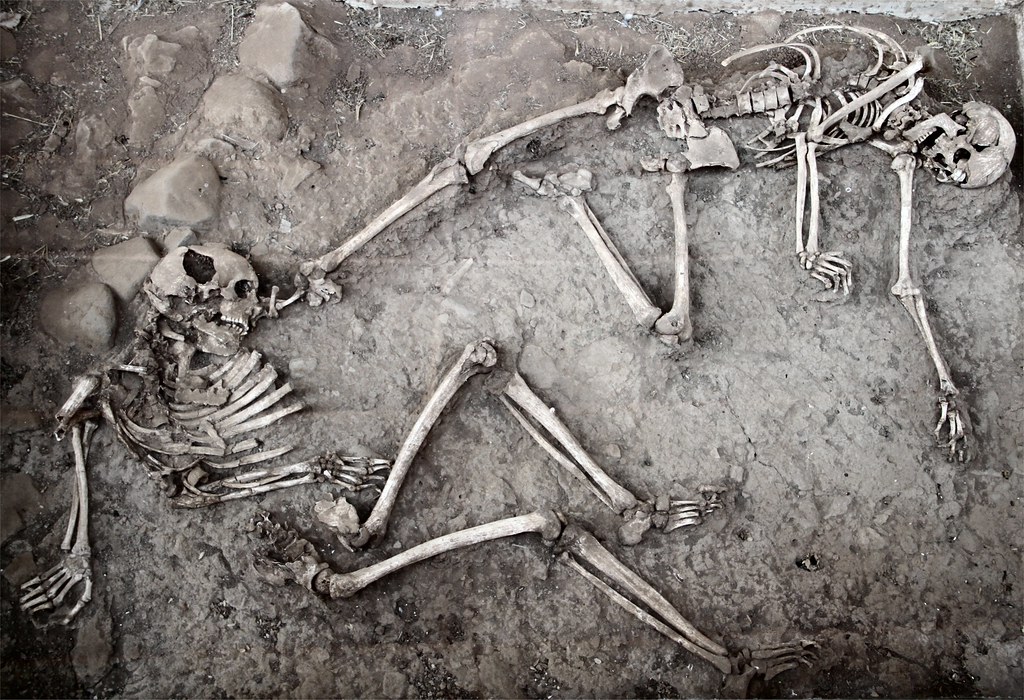
The archaeological history of the cave extends into the Bronze Age. The most remarkable finding from this later period is the skeleton of a woman named Sisàia by the researchers. Her remains date to approximately 1,600 BC. This burial occurred at the height of the Nuragic culture. Her skull displays a circular opening in the parietal bone, which is a clear sign of surgical trepanation.
Surgical trepanation is the practice of drilling or scraping a hole into the skull to treat head injuries or release pressure. The edges of Sisàia's skull opening show significant bone regeneration. This smooth bone growth is important evidence. It proves that she did not die during the operation. She survived the procedure and lived for several years afterward. This survival rate demonstrates the advanced medical and anatomical knowledge of Nuragic practitioners.
Her grave also contained cardial impressed pottery fragments and obsidian tools sourced from the volcanic Mount Arci. These volcanic glass tools show that the Nuragic communities maintained active trade networks across the island. The skull of Sisàia is preserved in the archaeological museum of Nuoro, where researchers continue to study it.
| Epoch: | Upper Paleolithic (13,500 BC) |
| Key Findings: | Oldest human bones, dwarf deer fossils |
| Neolithic: | Cardial impressed pottery (6,000 BC) |
| Bronze Age: | Nuragic grave, trepanned skull of Sisàia |
| Modern Era: | Bandit Giovanni Corbeddu hideout (1880) |
Yes. Excavations conducted by paleontologists revealed that human groups occupied the cave around 13,500 BC. This makes the skeletal remains found inside the cave the oldest human fossils discovered on any Mediterranean island.
Yes. The skull of the Bronze Age woman named Sisàia displays a distinct circular hole from surgical trepanation. Smooth bone growth around the edges proves she survived the procedure and lived for years afterward.
Yes. Researchers excavated numerous fossilized bones of extinct animals. These findings contain the bones of the dwarf deer Megaloceros cazioti, the wild dog Cynotherium sardous, and the giant rabbit Prolagus sardus.
Yes. Sardinia is covered in thousands of ancient ruins, most notably the unique stone Nuraghe towers, prehistoric tombs, and sacred sanctuaries built by the Bronze Age Nuragic civilization.
The oldest complex civilization is the Nuragic civilization, which developed during the Bronze Age around 1800 BC. Before them, various Neolithic cultures inhabited the island since at least 6000 BC.
The main megalithic structures are the Nuraghi (circular stone towers), Giants' Graves (communal megalithic tombs), and Domus de Janas (rock-cut chamber tombs) found across the island landscape.